Mini-Bar, Major Work: The Quiet Radicalism of the UK Hotel-Room Art Fair
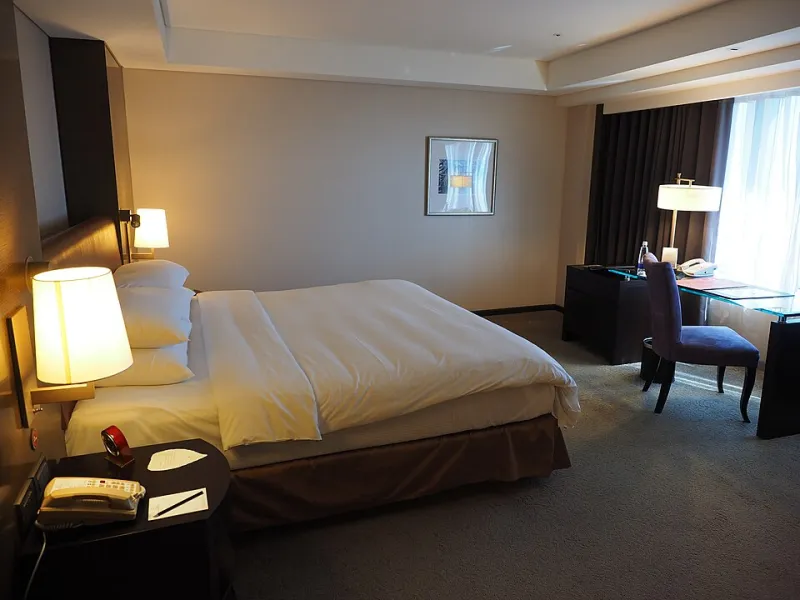
Photo: Nick-D, CC BY-SA 4.0, via Wikimedia Commons
I checked into a chain hotel off a ring road with a tote bag, a clipboard and the vague feeling that I was about to attend an art fair in a room where someone had recently watched breakfast telly. The bed was made. The kettle was still warm. And above it, carefully hung at eye level, was a small oil painting of a supermarket car park at dusk. It was £180. The price list was on the luggage rack.
This is the hotel-room art fair: part exhibition, part sleepover, part low-stakes market. In 2026, with white-tent fairs charging white-tent money, a growing number of UK artists and organisers are taking over budget hotels for a weekend and inviting the public to knock on doors. The booth is a bed. The plinth is whatever came with the room. The sales pitch has to survive the housekeeping trolley.
The room does half the curating
The first thing that strikes you is how much the architecture edits the art. A hotel room has one good wall, one bad wall, a mirror in the wrong place and a bedside lamp that turns everything the colour of a pub carpet. Artists who try to fight this lose. The ones who work with it tend to win.
At one event in Brighton, an exhibitor had hung three small collages on the wall opposite the bed and left the bed itself empty except for a folded blanket and a single price card. It looked deliberate, calm, almost monastic. At another, in Leeds, the artist had used the luggage rack as a plinth for a ceramic piece and the desk as a makeshift till. The kettle was still on the hospitality tray, but it had been moved to the bathroom. That felt like a curatorial decision.
The best rooms understand that the viewer is already in a strange headspace. You have walked down a corridor that smells of clean linen and faint chlorine. You have passed a sign about fire safety. You are standing in a room with a minibar price list and a wardrobe containing spare pillows. The art does not have to compete with the white cube. It has to survive the hotel room. That is a different brief, and a more interesting one.
What buyers do when there is nowhere to stand
In a conventional fair, visitors do a polite lap, take a photo, and leave. In a hotel room, they sit on the bed. They put their coat on the chair. They ask where the toilet is. The social distance collapses. Some artists find this excruciating. Others find it useful.
One organiser I spoke to, who asked not to be named because she was still negotiating next year’s room block, said the whole point is that people stay longer. ‘They cannot do the fast walk past you,’ she said. ‘They have to have a conversation. Sometimes that conversation is about the weather, and sometimes it ends with a sale.’
I watched a couple in their sixties spend twenty minutes in one room, not because they were serious collectors, but because the artist had put a chair by the window and offered them a cup of tea. They left with a £45 print and a recommendation for a decent chippy. That is not a typical art-market transaction. It is, arguably, a better one.
The economics of a room key
Hotel-room fairs are not new. Artists have been selling from bedrooms since the 1990s, and the format has popped up in London, Glasgow, Manchester and various seaside towns whenever rents and fair fees get silly. But 2026 feels like a moment. The cost of a shared room for a weekend is still a fraction of a stand at a mid-tier fair. For an artist with a few hundred pounds and a car boot full of work, that matters.
The trade-off is obvious. You cannot show large paintings. You cannot guarantee footfall. You are dependent on the hotel’s tolerance for blu-tack, extra visitors and the occasional person who mistakes the event for a wedding party. Insurance is a grey area. Security is a locked door and a hopeful expression. But the risk is lower, and the conversation is closer. In a year when everyone is talking about the death of the mid-market fair, the hotel room looks less like a novelty and more like a corrective.
The display tricks that actually work
After a weekend of room-hopping, a few rules emerge. Make the bed. A rumpled bed reads as a bedroom, not a gallery. Hang work on the wall opposite the window if you can, because the light is better and the viewer has somewhere to stand. Put the price list somewhere visible but not desperate. A clipboard on the desk is fine. A laminated sign taped to the TV is not.
Use the room’s furniture with a wink. A luggage rack makes a decent plinth. A towel rail can hold a small textile. The bedside lamp can be angled to warm a corner. But do not overfill. The rooms that work best have one clear idea, not six. The rooms that fail look like a car boot sale with a minibar.
And please, hide the kettle. Not because it is shameful, but because the kettle is the most powerful object in the room. It says domestic, ordinary, slightly damp. You want the art to be the thing people remember, not the complimentary teabags.
Where it gets awkward
There are limits. A hotel room is not neutral. It has a fire evacuation notice and a mysterious stain on the carpet. It has a bathroom that is either ignored or, worse, used as a viewing room. It has neighbours who did not sign up for an art fair. The best organisers manage this with humour and strict opening hours. The worst pretend they are in Basel.
But the awkwardness is also the point. Buying art in a hotel room is a slightly absurd act, and that absurdity strips away some of the pretension. You are not in a white tent. You are in a Travelodge. The artist is sitting on the bed. The work is leaning against the wardrobe. And somehow, in 2026, that feels like one of the more honest ways to sell a painting in Britain.