Two Quid, One Vision: The Volunteer Curators Making Britain’s Charity Shop Windows Sing
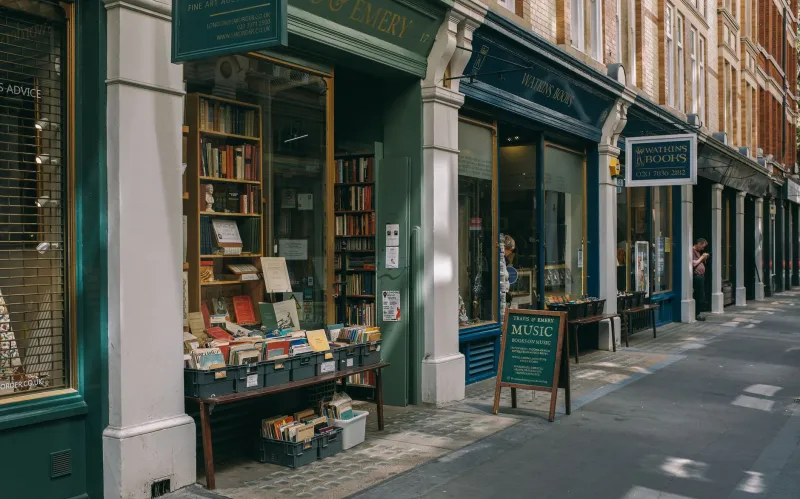
There is a particular kind of British high street window that stops you mid-stride. Not the polished one with the mannequins and the lighting rig. The other one. The charity shop window where a volunteer has taken a tray of donated ceramics, a faded scarf, three paperbacks and a ceramic hedgehog, and made something that looks suspiciously like a point of view.
You have seen it. Maybe you have walked past it twice this week without registering it. But once you start looking, the charity shop window becomes one of the most interesting exhibition spaces in the country. No budget. No wall text. No private view. Just a daily remit to sell the unsellable, and a volunteer with an eye and a roll of Blu-Tack.
The £2 Vase Has Entered the Chat
On Gloucester Road in Bristol, a window is built around a single £2 vase. It is a good vase — green, slightly wonky, the sort of thing that would sit on a gallery plinth with a label calling it “domestic vernacular.” Here, it sits on a stack of donated books, next to a fern that has clearly been borrowed from someone’s garden and a sign that says “Everything Must Go. Especially Brian.”
Brian is a ceramic frog. Brian is not going anywhere.
The volunteer behind this arrangement, who has been doing the window for four years, tells me she starts with whatever has arrived. “You cannot order stock,” she says. “You open the bags and you think, right, this week we have a lot of yellow.” So the window becomes yellow. Mustard jumper, lemon jug, a tin of custard, a paperback with a sun on the cover. It is not a theme. It is a response.
That is the first thing you notice about really good charity shop windows: they are reactive. They are not imposing a vision on the donations; they are listening to them. The yellow arrives. The yellow gets a window.
No Budget, No Wall Text, No Problem
Compare this to the average gallery. There, curation is often about control: the wall, the light, the sequence, the label. In a charity shop, curation is about constraint. You have no budget. You have no say in what comes through the door. You have a window that is probably too deep, too shallow, or blocked by a rack of Christmas jumpers in October.
And yet the decisions are the same. What goes at eye level? What needs breathing space? What is the story? Is the story “cosy autumn” or is the story “someone has donated an entire collection of commemorative plates and we need to move them by Saturday”?
In Glasgow, a volunteer on Byres Road shows me her trick: she arranges by colour first, then by height, then by “what would make someone stop.” She says the window is not for the browsers. It is for the people who walk past at speed. “You have got about two seconds,” she says. “If they look, they come in. If they don’t, they don’t. So you make the two seconds count.”
That is retail, yes. But it is also visual communication. It is composition under pressure. It is, frankly, better than a lot of group shows I have paid to get into.
The Glasgow School of Window Dressing
The best windows have a sense of humour. Not the forced kind, with handwritten signs trying too hard to be quirky. The dry kind. A hat perched on a lamp. A row of mugs facing the same direction like a staff meeting. A copy of a celebrity memoir paired with a single, slightly accusatory teaspoon.
There is also a seasonal rhythm to this work that galleries rarely manage. Halloween gives way to “cosy” gives way to “sparkle” gives way to “we are absolutely not doing Easter yet.” The volunteers know the calendar. They know that a window is not a static thing. It is a weekly, sometimes daily, edit.
And they know the price tags are part of the display. A £2 vase is not just a vase. It is an invitation. It says: this is achievable. This is not a £40 candle. This is a thing you can carry home in a paper bag and put on your own shelf. The price tag is the wall text, and it is more honest than most wall texts I have read.
Selling the Unsellable Is the Whole Brief
There is a temptation to call this “accidental art.” I think that undersells it. The volunteers are not accidentally making a tableau. They are deliberately making a window that works. They are thinking about colour, scale, repetition, humour, sightlines. They are doing it with donated clutter and a time pressure that would make a gallery curator weep.
They are also doing it for a cause. The window has to sell. The £2 vase has to become £2 for the hospice, the food bank, the animal shelter. That commercial imperative does not cheapen the display. It sharpens it. The best charity shop windows are a reminder that visual pleasure and practical purpose are not opposites. They are neighbours.
Give the Volunteers a Plinth
I am not suggesting we literally put a plinth in the window. The window is the plinth. But I am suggesting we stop treating these displays as the visual equivalent of background music. They are one of the most democratic forms of curation we have: free to see, constantly changing, made by people who are not paid to be geniuses and often are anyway.
So next time you walk past a charity shop window and clock a colour-coordinated shelf of mismatched china, a ceramic frog with a price tag, a yellow jug placed exactly where the light hits it, give it a second look. Somebody arranged that. Somebody thought about it. Somebody made the two seconds count.
And if you buy the vase, even better. Brian stays.