The Tea Towel Is the Edition: Notes on Britain’s Kitchen-Table Print Scene
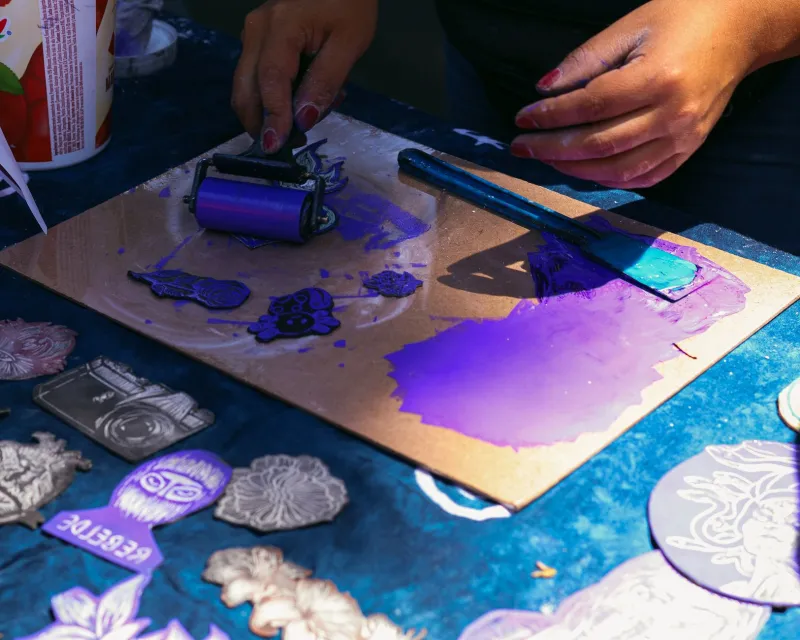
The dining table has been cleared, wiped, and covered with yesterday’s newspaper. A mug of tea sits dangerously close to a tube of black ink. Somewhere between the fruit bowl and the radiator, a piece of grey lino is being gouged into a small, wobbly masterpiece. This is not a studio visit. It is a Tuesday night in Britain, and the kitchen-table print scene is quietly having a moment.
You can call it a boom if you like, though nobody involved seems to be issuing a press release. It looks more like a spread: lino-cut clubs in pub back rooms, small-press fairs selling out of tote bags, shared studio nights with a communal brayer and a biscuit tin. The equipment is cheap, the learning curve is short, and the results are pleasingly imperfect. In 2026, the most interesting edition in the room may well be the one drying on a tea towel.
The table is the studio
A proper lino kit is wonderfully unglamorous. You need a sheet of lino, a gouge or two, a roller, a tube of water-based ink, a spoon for burnishing, and paper that can take a bit of abuse. Most of it fits in a shoebox. None of it requires a landlord’s permission or a three-phase electricity supply. That is the whole point.
The kitchen table is a flexible venue. It becomes a printing press after dinner and a drying rack before bed. The constraints are real — small runs, limited space, a cat with an interest in wet ink — but they also shape the work. Prints made at this scale tend to be modest, graphic and direct. A single image, one or two colours, a bit of misregistration. Nobody is trying to fake a studio in Shoreditch. They are trying to make something before the washing-up.
This is why the scene has spread so easily. Art shops and online retailers have made the tools accessible, but the real infrastructure is social: a friend who owns a brayer, a neighbour who knows how to register a second colour, a local print club that meets on the first Thursday of the month. The table is the studio, but the group chat is the studio manager.
A social habit disguised as a craft
Lino printing has always been a gateway craft. It is forgiving enough for beginners and stubborn enough to reward practice. What feels new is the number of people doing it together. In Bristol, Leeds, Glasgow, Lewes and plenty of places without a dedicated art scene, print nights are showing up in community halls, pub function rooms and shared workspaces. The format is simple: bring your own lino, use the communal ink, pay a few pounds towards the room, and get on with it.
The etiquette is gently enforced. Share the inks. Clean the brayer. Do not hog the good gouge. Bring biscuits if you have finished the last packet. These are small rules, but they turn a solitary craft into a social habit. People arrive with an idea and leave with a print, a phone number and a recommendation for a cheaper paper stock.
There is also something appealingly low-stakes about the whole thing. You are not applying for a residency. You are not building a brand. You are making a card for your mum, a patch for a jacket, or a print of the chipped mug you have owned since university. The kitchen-table scene thrives on that lack of preciousness. It is art as a practical joke, a gift, a reason to leave the house on a wet Wednesday.
What sells, what stays in the drawer
At small-press fairs, the economics are refreshingly clear. A hand-pulled print might go for £15 to £40. A tea towel might sell for £12 to £18. Cards do the quiet heavy lifting. Nobody is getting rich. The point is to cover the cost of paper and maybe buy a better roller.
The tea towel is the honest edition. It is useful, cheap enough to buy without agonising, and impossible to hang in a pretentious way. A print on a tea towel says: this image belongs in a kitchen, near a kettle, with a stain on it. That feels more truthful than a glossy gallery edition with a certificate and a price list. The tea towel is also a better story. It gets used. It gets washed. It gets commented on by guests who would never set foot in a private view.
Not everything sells, of course. Every printer has a drawer of prints that did not find a home: the experimental two-colour disaster, the portrait that looked better on the lino, the edition that never quite dried. The drawer is part of the process. It keeps the ego in check. It also makes the good ones feel earned.
The edition problem
The kitchen-table scene has an uneasy relationship with the word “edition”. In a gallery, an edition is a promise: a fixed number, a signature, a scarcity. At the kitchen table, an edition is more like a rumour. You print twelve, ruin three, give four away and sell the rest. The registration shifts. The ink coverage varies. The paper is whatever was on offer at the art shop.
That variability is not a bug. It is the texture of the thing. A kitchen-table print carries the evidence of its making: a thumbprint, a smudge, a slightly off-centre second colour. Those marks are not mistakes to be erased. They are the record of an evening. The edition is not diminished by its imperfection; it is defined by it.
This is why the scene feels like a counterweight to the polished end of the art world. It is not anti-gallery. It is simply pro-table. It values the shared brayer over the private view, the tea towel over the certificate, the drawer over the archive. It is small, inky and everywhere, and it is happening while the kettle boils.
Start with one gouge
If you want in, do not buy a press. Buy one gouge, one sheet of lino, one tube of ink and a cheap roller. Use a spoon to burnish. Print on paper from the recycling bin until you get the pressure right. Cut away from your body, keep your fingers behind the blade, and put a sheet of newspaper down before you start. Then find a local print club, a small-press fair or a friend with a table. The rest is tea and repetition.
The kitchen-table print scene is not asking for permission. It is asking for a bit of space, a shared ink pad and someone to hold the paper steady. That is a very British kind of art movement: modest, social, slightly sticky, and best experienced with a brew within reach.