Waiting Room Rules: A Field Guide to Britain's Bus Shelter Galleries
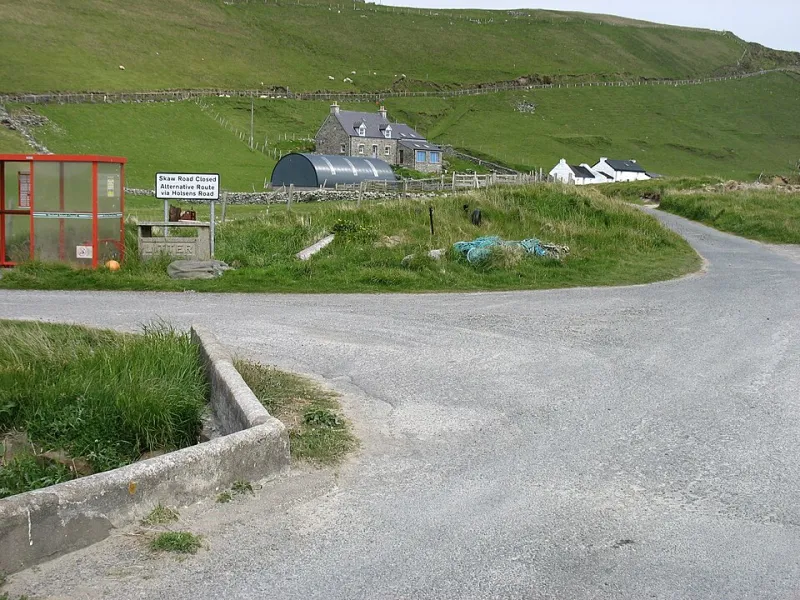
Photo: David Purchase , CC BY-SA 2.0, via Wikimedia Commons
The bus shelter is Britain's most honest gallery because nobody there wants to be in it. You didn't come for the art. You came because the 185 is late, again, and the wind is coming off the common at an angle that suggests personal malice. And then, while you're staring at nothing in particular, you notice that the panel where the ad should be has been replaced with a watercolour of the same road you're standing on.
That's the whole form in one moment. Art for people who didn't plan to look. Seven examples, one etiquette section, and an argument about why this might be the most efficient cultural infrastructure we have.
1. The painted panel
The classic. A local artist or school group repaints the advertising lightbox — often with council permission, occasionally without — with a scene of the immediate surroundings. The genius is the subject matter: the same parade of shops, the same church spire, the same bench. You are being shown the thing you're standing in, from a slightly better angle.
Why it works: it converts a waiting room into a viewpoint. It also quietly flatters the viewer, which is not nothing.
2. The poetry timetable
Some stops have gone in for lines set in the typeface of the real timetable. Bus times, then four lines of verse, then more bus times. It's disorienting in the best way — you read the poem because your eyes were already there for the 08:42.
It is also, structurally, the most honest piece of exhibition design in the country: the artwork is delivered in the same container as the information, so you can't tell where the civic service ends and the culture begins.
3. The knitted cosy
Guerrilla textile work, usually nocturnal, usually anonymous, often on a bench leg or a signpost. The craft equivalent of a post-it note. It lasts about three weeks before the weather or a broom gets it.
I'd defend the impermanence. A cosy isn't trying to be collected. It's trying to make one morning slightly less grim for a stranger, and then it's gone. There's a whole strand of contemporary practice that would kill for that clarity of intent.
4. The rogue installation
Every so often someone goes further. A chair placed deliberately. A mirror angled to catch the road. A small museum-style plinth with a single found object and a proper caption card, laminated, screwed down.
The rogue installation is where the form gets interesting, because it introduces a question of consent. Is this a gift or a trespass? Mostly the former. Occasionally the latter — and the person who has to remove it is usually on a zero-hours contract and does not need your project.
5. The anniversary stop
Village stops get decorated for Jubilees, centenaries, and the opening of a bypass. Bunting, laminated photographs of the high street in 1958, a laminated sheet explaining what used to be where the car park is.
This is local history as exhibition, and it's often genuinely excellent — partly because it's assembled by someone who has lived there for forty years and is not remotely interested in being tasteful about it.
6. The school takeover
Year Five takes over the stop for a term. Drawings of buses, drawings of dogs, one drawing of a bus with a dog driving it. Captions in pencil. Rain gets in; the corners go curly; everyone survives.
What's instructive here is the installation method: clothes pegs on string, run between two fixings. Twenty minutes' work, completely reversible, and it makes a boring shelter feel like it's been reupholstered.
7. The permanent-until-removed
Some pieces are simply left. A small bronze-ish bird bolted to the roof beam. A plaque. Nobody knows who put it there, the council has no record, and it has been there for years. This is not an exhibition, exactly; it's a fact of the place. But it counts.
The etiquette of looking while a bus is coming
This is where the form gets practical. A shelter doesn't give you the luxury of a slow read, so:
- Look once, properly. You get about forty seconds. Use them on one thing rather than glancing at everything.
- Don't stand in the sightline. If someone is watching for their bus, they need the road, not your shoulder.
- Photograph the work, not the people. Obvious, apparently, and yet.
- Don't adjust it. Straightening a corner is fine. Reworking the display is not yours to do.
- Say something if it's good. Not to the artist — they're not there. To whoever you're with. That's how these things get a reputation, and a reputation is the only funding this scene has.
Why this is the most efficient gallery in Britain
Count the cost. The footfall is free and involuntary. The opening hours are set by the timetable, which means the audience turns over every twelve minutes. The installation costs about as much as a round of drinks. There's no invigilation because there's nothing to invigilate beyond human decency, and that mostly holds.
And critically, it reaches people who would never cross the threshold of an arts centre — not out of hostility, but because there's no reason to. The shelter gives them one. It's the same road they're already on, drawn better.
I'm not going to pretend a knitted cosy is a Turner Prize entry. But as a delivery mechanism for looking at things carefully in public, the bus stop is doing more work per pound than almost anything with a press office. And it never once asks you to sign up for a newsletter.
Mind the gap. The 185 is coming.