Nobody Ever Read the Wall Text Twice: A Case for the Scribbled Bio
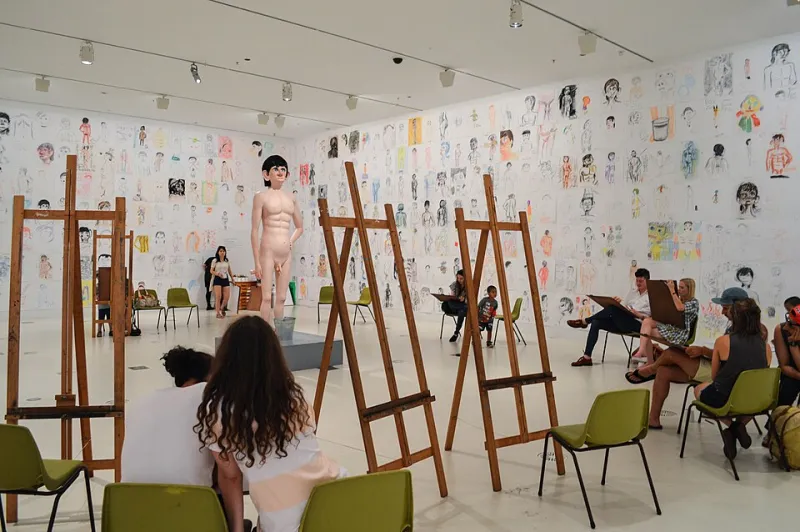
Photo: Tmtm, CC BY-SA 3.0, via Wikimedia Commons
There is a particular sound in a British gallery on a quiet Tuesday afternoon. Not the hush you'd expect. It's the soft clack of a laminated wall text being skimmed and abandoned — three paragraphs about liminality, a mention of "the body as site", and then a small, resigned shuffle towards the actual work. I've watched it happen at least forty times this year, in spaces from a converted chapel in Bristol to a room above a chippy in Salford. Nobody finishes reading. Almost nobody starts.
And honestly? Fair enough.
The bar between you and the thing
I want to be careful here, because I like curators, I like theory, and I have read more than my share of it on trains. But somewhere along the line, the artist statement stopped being a doorway and started being a bouncer. It stands at the entrance to a show checking whether you've done the reading. If you haven't — if you wandered in off the street because the lights were on and there was free wine — the statement politely implies you might not be qualified to have an opinion.
That's a crime scene, and the victim is curiosity.
Ask anyone who runs an open studios weekend and they'll tell you the same thing. People want to know three facts: what it's made of, how long it took, and whether the artist was thinking about anything in particular when they made it. That's it. That's the whole appetite. And somehow we've decided the answer has to arrive in passive voice and reference a philosopher.
What the open-studios people told me
I spent a chunk of this autumn bothering anyone with a clipboard and a roll of masking tape. The organisers are the unsung epidemiologists of all this — they see thousands of ordinary visitors a year and they know exactly where attention drops away.
One co-ordinator in Sheffield keeps a note in her folder of the questions visitors actually ask out loud. It is a short list and it runs roughly: Is that a photo or a painting? What's it made of? How long did that take you? Do you sell the small ones? Not one single person has ever asked about the artist's relationship to the "post-industrial vernacular".
Michaela, who paints big, slightly unnerving kitchen interiors, told me she once wrote a statement so dense that her own mum asked her to "do a normal one". The normal one — four lines in biro, taped to the door of her studio — got photographed more than the paintings. People read it twice. Some came back the next day to read it again.
"I wrote what it was, why I started, and that I'd run out of blue halfway through and had to improvise. That last bit started more conversations than anything I've ever hung on a wall."
That's the whole argument, really. Specificity is generous. Abundance is not.
Three paragraphs of theory, one sentence of truth
Here's what gets lost when every show arrives shrink-wrapped in abstract nouns: the work stops being able to speak for itself, and the viewer stops trusting their own eye. There is a real pleasure in not knowing — in standing in front of something and being allowed to have a stupid, immediate reaction to it. A wall text that pre-explains the work steals that pleasure and calls it context.
I'm not arguing for ignorance, and I'm certainly not arguing for dumbing anything down. Breadth of reference is lovely. But a viewer is not a viva panel. You don't have to prove you've read the set texts to be allowed into a room.
And there's a practical point hiding in all this: the writers of these statements hate writing them. Ask any artist whose practice is currently being summarised in the third person and watch their face do something complicated. We have collectively invented a document that nobody enjoys writing, nobody finishes reading, and everybody feels slightly judged by. It is, by any reasonable measure, the least efficient piece of prose in British cultural life.
The beermat method
So here's the small, unglamorous alternative — and I'd genuinely like to see more of it in 2026.
Write it as if a friend has just come into the studio and asked what you've been up to, and you've got about forty seconds before the kettle boils. Four prompts, no more than two sentences each:
- What is it? Materials, size, whether it's a painting or a print or mysteriously neither.
- How did it start? One sentence. The actual starting point — a colour, a complaint, a photograph on your phone.
- What surprised you? This is the sentence that makes strangers stop and talk. It's always the best one.
- What do you want to know? An invitation, not a conclusion.
Then write it by hand if you can bear it, or type it and don't justify the margins, and pin it up where the work is. Not a book. Not a plinth-length slab of card. A beermat of a bio.
The handwritten label as a small act of courage
There's something quietly radical about a label that admits a person made the thing on purpose, and that the person had a bad afternoon once and it went into the work. Handwriting does that. It carries the trace of a body — the slightly wonky height of the letters, the moment the pen ran out. It's the opposite of a statement that has been through three rounds of institutional editing and now describes the work from a great, safe distance.
I've seen this done beautifully at a tiny project space in Margate, where every piece had a single index card beside it: title, year, material, and one line in the artist's own hand. Some lines were funny. One said "I don't know why I kept this, but here we are." I spent longer in that room than I've spent in some national collections, and I remember four of those cards now, months later. I cannot remember a single wall text I read in 2026.
That's the test, isn't it. What do you carry home?
For the curators, who are not the villains
I'll finish with a note for the people hanging the shows, because the statement-industrial complex isn't really their fault. Funding forms demand a rationale. Press offices want a hook. Somewhere a template got handed down and everyone has been dutifully filling it in ever since.
But there's room to be a little braver. Print the plain version next to the work. Keep the long version online for the people who genuinely want it — they'll find it, they always do. Let the room be quiet and the beermat do the talking. Trust the visitor to arrive with a functioning brain and a bit of curiosity and no glossary whatsoever.
Because the truth is, most people came in to look at something. The least we can do is not stand in the way with three hundred words about the liminal.