The Best Studio Crit I Ever Had Cost £11 and Came With a Thermos
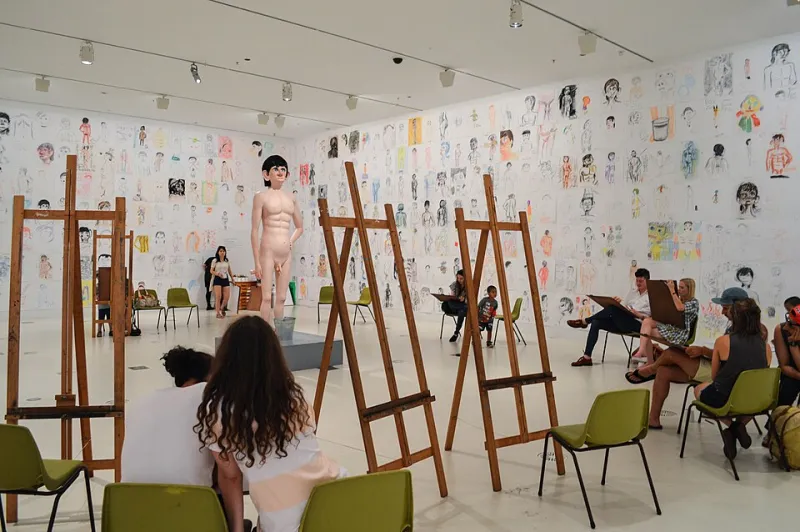
Photo: Francisco Anzola, CC BY 3.0, via Wikimedia Commons
There's a table in a church hall in Leeds with a wobble in one leg, and every Tuesday between September and Easter somebody puts a folded beer mat under it. On that table: a jam jar of brushes, three tubes of paint with the lids welded on, a flask, and whatever the group is working on. Around it, eleven adults of wildly different abilities are trying to draw a person sitting on a stool under a standing lamp.
I've been to private views this year with better canapés and worse conversation.
The Quiet Comeback Nobody Is Posting About
Adult evening art classes are having a moment, and it's the least glamorous moment in the culture. Waiting lists at local authority adult education providers. Life-drawing sessions in cricket pavilions and Working Men's Clubs that fill within a day. Community darkrooms running beginners' nights that sell out to people who have never touched an enlarger. None of it trends. All of it is booked solid.
Part of this is straightforward: people want a room, a time and a reason to make something that isn't work. Part of it is the slow collapse of the idea that you need a studio, a qualification or permission. But I think the real draw is something the art world has been quietly outsourcing for years — the crit.
What a Crit Actually Is
A studio crit, for the uninitiated, is the bit of art school where everyone stands around your work and says what they see. It is not always kind. It is, at its best, the most useful forty minutes an artist can spend: a room of people who owe you nothing telling you what your work is actually doing, as opposed to what you hoped it was doing.
A good tutor running an evening class does a version of this without calling it that. The tutor in Leeds — twenty years of teaching, a practice of her own, an unhurried manner — moves around the room and says small, load-bearing things. That's a drawing of a hand, not a hand. Stop looking at the paper. You've got three darks and one light, flip it. Nobody is being graded. Nobody is paying £9,000 a year to be there. That turns out to matter enormously.
Low Stakes, High Standards
Here's the case for the night class over the polished gallery visit, and I say this as someone who enjoys a polished gallery visit.
A gallery shows you finished work, separated from its failures by time, framing and a wall text. It is inspiring and it is also, structurally, a lie of omission. You see the resolved object, never the eleven bad versions. A draughty hall shows you the process in real time — including your own — and it does so in company. The person on your left is worse than you and the person on your right is better, and both of those are useful facts.
The stakes are low enough to be brave. There is no degree riding on it, no funding application, no open call. You can make something genuinely terrible on a Tuesday and come back the following week without shame. That freedom is exactly what side projects need, and it's precisely what a portfolio or an Instagram grid quietly removes.
The Rooms Are Full of Side Projects
Almost everyone I've spoken to in these classes has something else going on. The woman doing careful tonal studies of her late father's tools, heading towards a small book. The bloke in the corner drawing the same bus shelter every week until it became a series of forty. A retired nurse making cyanotypes of the plants in her allotment on a community darkroom's Wednesday slot.
None of these would get past a commercial gallery's programming meeting. All of them are more alive than half the concept-led group shows I've stood in this year. Night school is where a lot of British side projects are currently incubating, unseen, at eleven pounds a session.
The Cost of Showing Up
Let's be honest about the barriers, because they're real. Classes cost money, and the cheapest ones have been cut hardest — adult education budgets have taken a beating for over a decade, and plenty of providers now run only what pays. Halls are cold. Materials add up. If you're a carer or you work evenings, a fixed weekly slot can be impossible.
But where the provision survives, the value is absurd. Two hours a week, a table, a lamp, and a person who will look at your work and tell you the truth. Compare that to a ticket, a train fare and an hour of shuffling past other people's resolved objects in silence.
How to Find One
Search your council's adult education listings before anything else — they're often buried, badly indexed, and cheaper than anything commercial. Look up your local arts centre, your nearest camera club (many have darkrooms and are desperate for new members), and the noticeboard in the sort of café that sells second-hand books. Ask in independents' framing shops; they know who teaches what and where.
Then turn up badly. Take a cheap pad and something to make marks with. Don't buy the whole kit before the first session, because half the people who do never come back for week three.
The table with the wobble will still be there. Somebody will have found a beer mat.