Wrong Colour, Right Price: A Field Trip Through Britain's Mis-Tint Economy
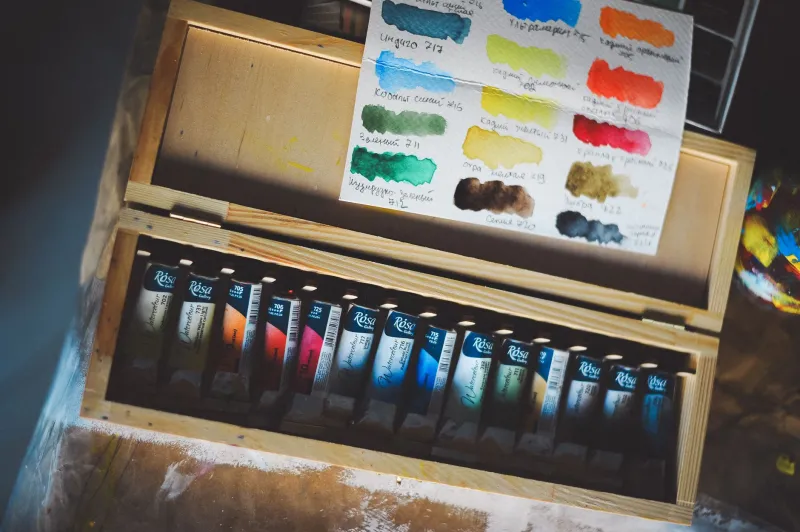
There is a particular shade of green that exists only on the mistint shelf. Nobody chose it. It is the colour a machine produced when someone asked for sage, changed their mind at the till, and walked out. It sits there in a 2.5-litre tin with a hand-scrawled sticker and a price that feels like a clerical error. And somewhere in Britain, right now, an artist is buying it by the armful.
I've been mildly obsessed with these shelves for a while. Not because I'm thrifty in a smug way — I once paid £14 for a single posh tester pot out of pure panic — but because the mistint aisle is the last place in this country where colour happens to you rather than the other way around. You don't go in for a colour. You go in for whatever the machine got wrong that week.
The shelf where colours go to be forgiven
Walk into any large DIY store and look for the paint desk. Behind or beside it, there'll be a rack of tins marked down: mistints, discontinued lines, damaged stock, the odd can someone ordered and never collected. Prices are usually between £3 and £8 for a 2.5-litre tin, which is roughly the cost of a coffee and a pastry in a nice part of Leeds. Occasionally you'll find a 5-litre bucket of something truly unhinged — a lilac, a violent terracotta — for a tenner.
The stock turns over fast and unpredictably, which is the point. You can't plan a project around it. You can only develop a relationship with it, the way you'd develop a relationship with a car boot that always has good chairs. Dean Whitmore, a painter in Sheffield who's been working almost exclusively from reclaimed emulsion for four years, told me he checks his two nearest stores on the same loop as his supermarket shop. "It's not a hobby, it's a habit," he said. "The trick is you have to be willing to have your idea ruined by what's on the shelf."
That's the whole aesthetic, really. Not 'upcycling' in the twee sense, but a kind of negotiated colour theory. You arrive wanting to paint something warm. You leave with three tins of cool grey and a plan for something else.
What a reject actually costs
Let's do the maths, because this is where the romance meets the receipt. A standard 2.5L tin of mid-range emulsion retails around £20–£28. A mistint of the same volume goes for £5. A 750ml tester, normally £4–£6, sometimes appears in the reduced bin for £1.50. Timber offcuts from the cutting bench at a big DIY shed are frequently free or a pound or two — ask at the desk, they're usually delighted to hand over the bin. Broken or end-of-line tiles, the ones with chipped corners or a discontinued pattern, get cleared at 50p a piece in the clearance aisle, or free from a skip if you're bold and polite.
The economics get interesting when you scale up. A studio wall piece in a 1.5m format might need half a litre. That's about a pound of paint. The frame or panel is where the money goes, which is why so many of the artists I spoke to are building on found board, old doors, or the backs of discarded canvases from art-school clear-outs. The paint is essentially free; the discipline is in the surfaces.
There's also a quieter economy here: Community RePaint, the UK network that redistributes leftover and surplus paint to community groups and individuals. It's been running for decades and it is, frankly, one of the better-kept secrets in British making. A fiver there buys you a proper tin, sometimes a matched set, and you're keeping something out of the waste stream. Look up your nearest scheme before you drive to the retail park.
Studio visit: the people painting in forgotten greens
I spent an afternoon in a shared studio in Bristol — three makers, one long room, a kettle that has seen things. The walls were a patchwork of test patches, the kind of thing that looks chaotic until you realise it's a working colour library. Every patch is labelled in pencil with the store, the date and what it turned out to be.
"I stopped buying colour I've chosen," one of them said, stirring a tin of what can only be described as 'wrong olive'. "If I choose it, I know what it'll do. If the shelf chooses it, I have to learn it." She uses rejects as ground layers, building up thinned washes until the 'mistake' becomes the undertone. From two metres away the finished panels read as considered, almost restrained. Up close they're a mess of accidents that got along.
The other thing I noticed: nobody was being precious. Reject paint encourages a certain looseness because you didn't pay enough to be afraid of it. There's a lesson in that for anyone who's ever stared at a blank canvas and a £30 tin of Farrow & Ball.
The aesthetics of almost-right
Here's the thing the craft-shop version of this story usually misses. Making art from reject materials is not the same as making 'rustic' things. The interesting work in this space is precise, edited and often quite hard-edged — geometric panels, flat colour fields, screen-printed surfaces. The material is cheap; the eye is not.
The palette that emerges from the mistint shelf is genuinely distinctive: dusty, slightly off, full of the greens and ochres and murky pinks that proper colour charts avoid. It reads as contemporary because it's awkward. Nothing matches, so everything has to be composed. If you want a shorthand, think of the difference between a nicely coordinated room and a room with one wrong chair in it. The wrong chair is doing all the work.
A practical guide, without the clutter
If you want to try this, a few rules of thumb from people who've been at it a while.
Source deliberately, not randomly. Pick two or three stores within your normal weekly orbit and check them on a schedule. Add your local household waste recycling centre, Facebook Marketplace, Olio and Freecycle. Ask at the timber cutting desk. Be nice to the person on the paint desk; they'll tell you when the reductions land.
Store small. Decant into labelled jars — the 500ml deli tubs are perfect — and write the date and the store on the lid. Keep a swatch card of each colour in a ring binder. A studio with forty tins on the floor is a hazard; a studio with forty labelled jars on a shelf is an archive.
Test on the actual surface. Reject emulsion can be old, thick, or oddly matt. Paint a patch and leave it a week. Some of it will be fine; some of it will be a nightmare. Learn which is which before you commit.
Don't hoard. The great trap of cheap material is the belief that you'll use it eventually. You won't. If a tin hasn't been opened in two years, give it to Community RePaint and get your shelf back.
Edit hard. This is the bit that separates the work from the clutter. Choose three colours per piece, maximum. Let the surface do the talking. Resist the urge to add a fourth thing because you have it.
The point of the wrong colour
The mistint shelf is not a secret, but it is underused, and not for the reasons you'd think. It's not that people don't know about it. It's that the whole proposition — you don't get to choose — is quietly uncomfortable. We're trained to want the colour we wanted.
Which is exactly why the work coming out of these studios looks so alive. Somebody handed these makers a green they'd never have picked, and they made something out of it anyway. That's not thrift. That's a practice.
Next time you're in a DIY store and you see that rack of unclaimed tins, have a look. Not to buy anything. Just to see what the machine got wrong this week.