Three Pounds, Well Lit: The Home Galleries Quietly Being Curated in British Car Boot Queues
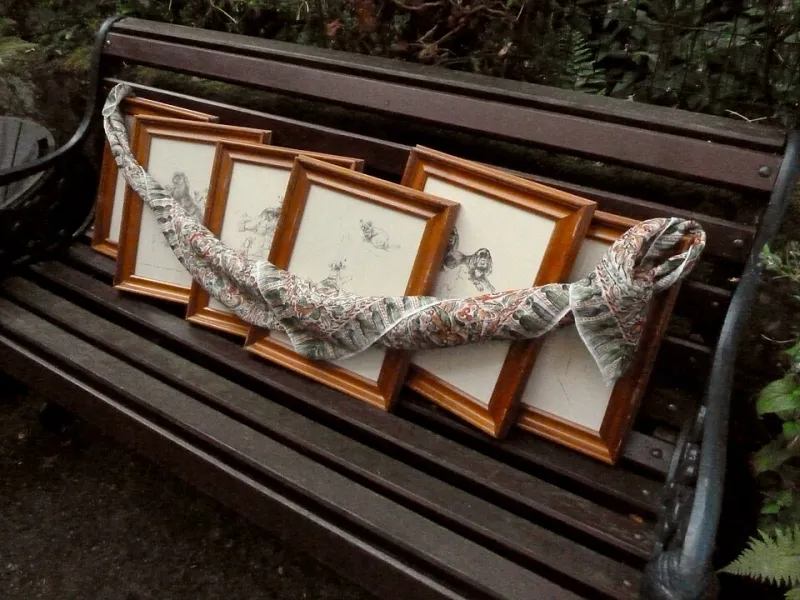
Photo: Storye book, CC BY-SA 4.0, via Wikimedia Commons
There is a specific hour on a Sunday when a British car boot sale stops being a market and becomes a rummage. Around 7.40am, the light is still flat, the tea is still in a flask, and the sellers are pricing things by feel rather than logic. A framed etching goes for three pounds because it's chipped. A box of ceramic tiles goes for a fiver because the seller can't remember where they came from. Nobody is buying for investment. Everybody is buying for the story.
That hour, it turns out, is producing some of the most interesting domestic displays in the country.
The Hallway That Behaves Like a Room
Take Ellen, who lives in a 1930s semi outside Sheffield and has turned a hallway barely wide enough for a coat rack into the tightest, most confident hang in the house. Eleven pieces, all sourced from car boots, house clearances and the sort of charity shops that smell of furniture polish. Nothing cost more than £12. Two things were free.
Her rules are almost aggressively simple. Nothing hung higher than eye level. No more than three frames of the same material in a sightline. And every piece gets a small, handwritten card — name if known, price paid, and where it was found. "It started as a joke," she says. "Now guests read the wall before they take their coats off."
That labelling instinct is the thing that separates a collection from an accumulation. Museums do it because they have to. Amateur curators do it because it turns a £3 object into a small piece of research. A chipped tile with a note saying "Burslem, 1930s, £2, Newark car boot" is more interesting than the same tile with no note at all. The information is the value.
Restraint Is the Whole Trick
If there's a shared philosophy among the people doing this well, it's subtraction. Almost everyone we spoke to described a phase of buying too much, followed by a ruthlessly unsentimental cull.
Marcus, who has a flat in Bristol with one very good wall and three very ordinary ones, keeps a box in the cupboard he calls "the bench." Anything new goes in there for a month. If it's still interesting after four weeks, it earns a hook. If not, it goes back out — usually to a charity shop, occasionally back to a car boot, which he describes as "returning it to the wild."
"The mistake everyone makes is hanging everything," he says. "A wall with four things on it looks like a decision. A wall with nineteen things on it looks like a hobby." There is a whole genre of interior content built on maximalism, and it can be glorious, but it is also much harder to pull off than the quiet version. Restraint is cheaper and it fails more gracefully.
Lighting, or Why Your Best Find Looks Like a Smudge
Here is the unglamorous truth: most home collections are ruined by the ceiling light. A £4 print under a bare bulb at 9pm will look like a stain. The same print lit from the side by a cheap picture light — or even a clip-on book light, which several people admitted to — suddenly has depth.
Kit, a retired teacher in Norfolk, has a system she describes with genuine glee. Two rechargeable picture lights from a certain online retailer, rotated between pieces depending on the season. Nothing hardwired, nothing permanent, nothing that needs an electrician. "You're not lighting a gallery," she says. "You're just giving the thing a fair hearing."
She also swears by taking a photograph of any potential purchase in daylight before committing. Framed glass, in particular, lies to you in a field at dawn.
Taste Isn't a Budget Line
The thing that strikes you after a few of these conversations is how little the money matters and how much the looking matters. The people with the best walls are not the ones with the most money. They are the ones who have learned to say no in a field full of objects, and who have developed an eye for the sort of thing that gets overlooked because it's slightly odd — a hand-tinted postcard, a pub ashtray, a wonky bit of studio pottery with a hairline crack.
That last category is the great British tradition. There is a particular pleasure in a damaged object that has been kept anyway, and it runs from Cornish slipware to the mug you refuse to throw out. A crack is evidence of a life. Conservators would rather it weren't there. Collectors at car boots tend to find it charming.
A Field Guide, If You Fancy a Go
If you want to start, a few things worth knowing. Go early but not first — the dealers take the obvious things, and the interesting things are usually still there at half eight. Take cash in small notes and a bag that isn't a tote with a hole in it. Ask where things came from; sellers love being asked and it costs nothing. Photograph what you buy before you clean it — you'll want to know what it looked like when it was found.
And buy one thing you can't justify. That's usually the one that ends up staying.
The point of all this isn't thrift as a personality. It's that curation is a skill available to anyone with a free afternoon, a bit of restraint and a wall that gets decent light. Britain is full of small, excellent, entirely unpublicised collections hanging above radiators and behind doors. Nobody is charging admission. Most of them would probably put the kettle on if you asked.