Galleries Are Whispering. UK Art Should Clear Its Throat.
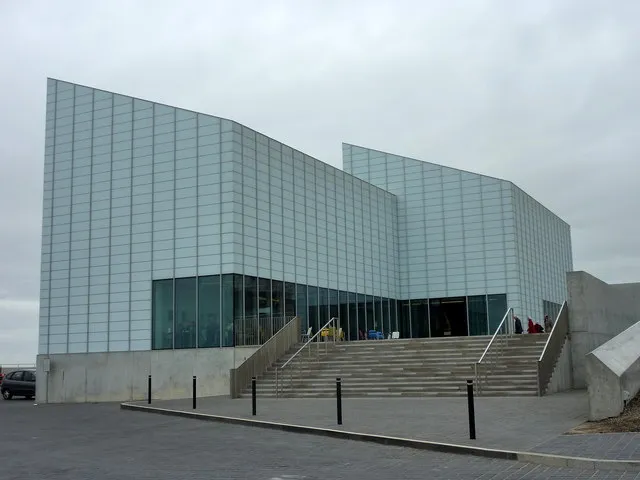
Photo: pam fray , CC BY-SA 2.0, via Wikimedia Commons
There is a particular hush in a certain kind of UK gallery. Not the good hush of concentration, but the hush of a library where someone might tell you off. Wall texts in nine-point grey. Ambient drone. A bench you are not entirely sure you are allowed to sit on. Everyone behaving. This is not a problem of art. It is a problem of worship.
The UK's best cultural work has always had a wink. Music hall, Punch and Judy, punk flyers, Caribbean carnival, pub poetry, the rude seaside postcard. We have a long tradition of art that elbows you in the ribs. Somewhere along the line, serious became a synonym for solemn, and solemnity became the default setting.
The Reverence Problem
Walk into too many institutional shows and you can feel the air leave the room. The press release uses the word interrogation. The audio guide sounds like a eulogy. The audience is treated as a congregation, and the artwork as a relic that must not be questioned too loudly. You are allowed to be moved. You are allowed to be challenged. You are not encouraged to smile.
This has consequences. It makes contemporary art feel like homework. It makes people who might love it feel excluded. It also makes bad work harder to spot, because everything is delivered in the same hushed register. If nothing can be funny, nothing can be properly judged.
What Cheek Actually Does
Wit is not the same as cynicism. It is a form of hospitality. It says: come in, you are among friends, you are allowed to have a reaction. Street art that makes you look up. An open-mic night where failure is part of the ticket price. A zine fair where someone will trade you a badge for a conversation. These are not lesser forms. They are social contracts.
Humour is a precision tool. It can hold contradiction. It can let people in without lowering the bar. It can puncture pretension without dismissing care. The best cheek is not a heckle. It is an invitation.
The Balance: Spaces That Get It Right
A project space above a chip shop in Margate has a simple policy: every exhibition includes one thing you can touch and one joke in the wall text. It sounds gimmicky. It is not. It forces the curator to think about the body in the room and the mind reading the label.
A Glasgow artist-run space runs a regular Worst Idea night, where makers present the project they are most embarrassed by. The audience is generous because everyone has a worst idea. The work is often better than the polished stuff.
A pub back room in Sheffield hosts a monthly night of performance art with a strict five-minute limit and a raffle. The raffle is not a metaphor. It is a raffle. The work is strange, funny, occasionally brilliant and never precious.
These spaces share a quality: they are confident enough to be informal. They do not confuse accessibility with stupidity. They curate with a wink, not a shrug.
A Playful Manifesto for Curation
- If the wall text cannot be read standing up, rewrite it. If it can be read standing up but says nothing, rewrite that too.
- Every exhibition needs one moment of deliberate silliness. One. Not a theme park. A moment.
- Do not confuse obscurity with depth. Confusion can be interesting, but it is not automatically a virtue.
- Let the audience be co-conspirators, not pupils. Give them something to do, touch, move or argue with.
- Program the local, not just the legible. The best work in the room may come from ten minutes away.
- Leave room for failure. A programme with no risk is a programme with no pulse.
- End with tea, not a panel. Conversation is better when everyone is holding a mug.
The Wink Is Not a Gimmick
There is an obvious objection: humour can be an excuse for low standards. It can. A joke at the start of a bad show is a distraction. A joke at the end of a good one is a gift. Cheek requires rigour. It requires knowing the rules before bending them. The wink should be earned. It should be the last thing, not the first.
This is why the best irreverent work is rarely careless. It is carefully built to look carefree. The artist has done the thinking so the audience can do the feeling. That is craft.
Clear Your Throat
UK art does not need to be louder. It needs to be less afraid. Less afraid of being liked. Less afraid of being silly. Less afraid of being local. We can keep the reverence for the work. We should drop the reverence for the room.
The cultural scene is not a temple. It is a conversation, and conversations are better when someone is allowed to make a joke. So let us stop whispering. Let us clear our throats, have a laugh, and get on with it.